Breast Implant Size in Riyadh How Surgeons Approach the Decision
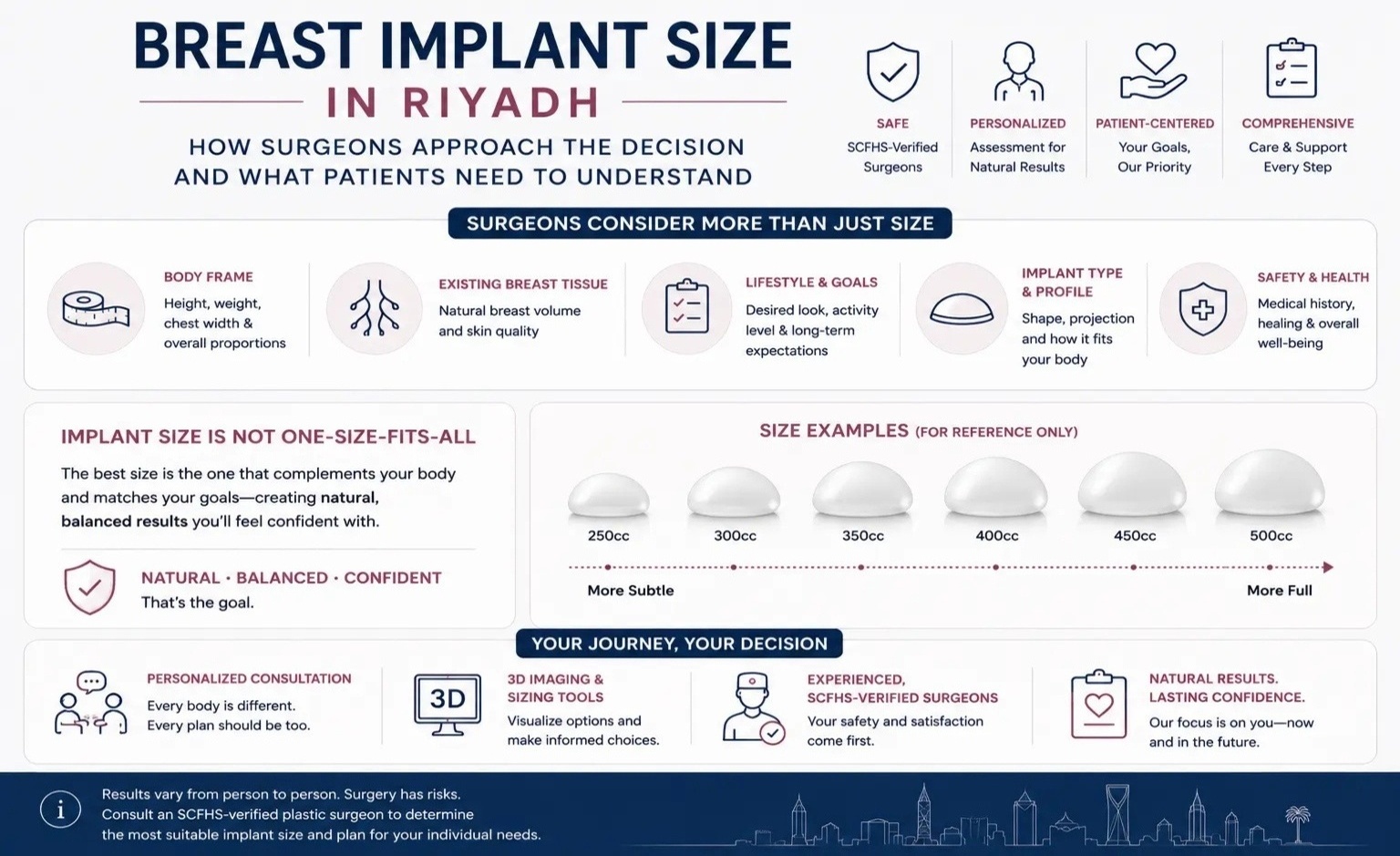
Breast implant size is the most-asked question before augmentation surgery — and the one with the least useful generic answer. The right size depends on your chest measurements, existing tissue, and skin, not just a number in cc. This guide explains how surgeons in Riyadh actually approach that decision.
Why cc Volume Alone Doesn't Tell You Much
Searching "what does 300cc look like" won't give you a reliable answer, because the same volume looks different on every patient. What actually changes the outcome:
Chest width — a narrow chest can't safely take a wide implant
Existing breast tissue — less tissue shows more of the implant's shape
Skin elasticity — tighter skin limits how much volume is safe in one session
Projection vs. width — the same volume can be shaped forward (high profile) or wide (low profile)
Placement — under the muscle typically needs slightly more volume than over it, for a similar look
How Surgeons Actually Size You
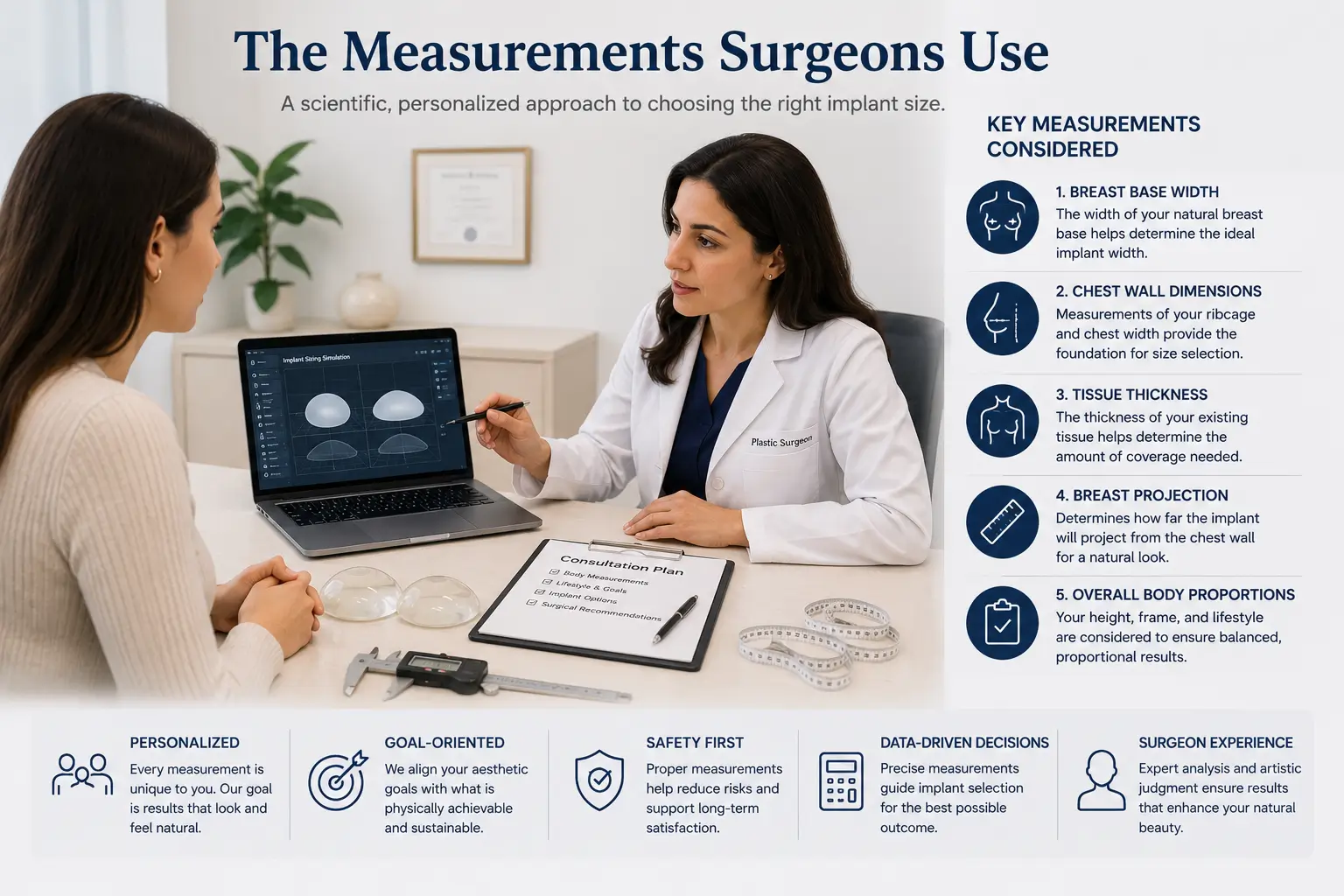
At consultation, your surgeon measures your base width diameter (BWD) — the width of your natural breast footprint — along with tissue and skin characteristics. This is the foundation of tissue-based planning, the standard approach used by most surgeons today.¹
Common methods you'll encounter in Riyadh:
Tissue-based planning — implant chosen to fit your measurements, not a size preference
3D imaging — a computer simulation of different sizes on your own body (available at some clinics; a visual guide, not a guarantee)
Sizers — trying temporary volume in a bra to get a feel for size
Good question for your consultation: which sizing method do you use, and why?
What cc Generally Looks Like
This is a general guide, not a promise — the same cc looks different on different bodies.
Volume General Result150–250ccSubtle change, close to one cup size250–350ccModerate change, roughly one to two cup sizes350–450ccNoticeable change; needs enough chest width and skin to support it450cc+Substantial; needs a specific anatomy assessment, carries more long-term risk if the fit isn't right
Rule of thumb: about 150–200cc ≈ one cup size, but cup sizes vary by brand and aren't a real measurement — surgeons plan in cc and chest measurements, not cups.
Have questions? AskZaina for general guidance — Zaina answers general questions about the process but doesn't take your personal measurements or photos and won't give you a personal size recommendation. That part is always your surgeon's, in person.
SFDA-Approved Brands
All implants sold in Saudi Arabia need SFDA Medical Device Marketing Authorization as Class D devices.² Brands currently authorized include Motiva, Mentor, Allergan Natrelle, Sebbin, and Polytech — ask your clinic for the MDMA registration number of the specific implant proposed for you.
Indicative Cost in Riyadh (SAR)
Method Range Notes Standard silicone implants15,000–27,000Most common option Motiva implants20,000–35,000Higher material cost Fat transfer (no implant)20,000–25,000Natural feel, ~1 cup size max per session Hybrid (implant + fat)25,000–40,000For larger volume with natural contour
Always get a written, itemised quote — prices vary by surgeon, brand, and case complexity.
Ask This at Your Consultation
What's my BWD, and what implant range fits it?
Which sizing method do you use?
What profile — low, moderate, high — suits my goals?
Can I see 3D simulations or before/after's of similar patients?
What happens to the result if my weight changes significantly?
There's no right cc number that applies to everyone — the right size is the one that fits your chest, tissue, and goals, decided together with your surgeon at an in-person consultation. Going in with the right questions is what makes that conversation useful.
Ready to find a surgeon in Riyadh? Browse SCFHS-registered plastic surgeons and compare options →
FAQ
Can I just pick any size I want? Not safely. Sizes outside your anatomical range raise the risk of bottoming out, rippling, and capsular contracture over time.³ Your surgeon works within your safe range to get as close as possible to what you want.
Do bigger implants mean more risk? Volume alone isn't the risk factor — the fit between implant and your anatomy is. That needs a physical exam to assess.
Can I change the size later? Yes, via a revision surgery — a second procedure with its own cost and risk. Talking through your long-term goals up front reduces the odds you'll need one.
Is it harder to remove a bigger implant later? Removal is possible at any size, but skin and tissue may not fully bounce back, especially after years. Worth discussing if you're younger and thinking long-term.
If you notice fever, worsening pain, redness, discharge, or changed sensation after any procedure, seek medical attention promptly.
References
Tebbetts JB, Adams WP. Five critical decisions in breast augmentation using five measurements in 5 minutes: the high five decision support process. Plast Reconstr Surg. 2005;116(7):2005–2016.
Saudi Food and Drug Authority, Medical Devices and Supplies Regulation (2021), MDS-REQ-001.
Headon H, Kasem A, Mokbel K. Capsular contracture after breast augmentation: an update for clinical practice. Arch Plast Surg. 2015;42(5):532–543. See also: retrospective study, Frontiers in Surgery, 2025, identifying implant oversizing as a significant risk factor for capsular contracture.
Internal, not for publication: SaMD classification for Ask Zaina, PDPL privacy notice, AMDA advertising check, live SFDA brand-list date-check, and internal link verification are still open with legal/compliance — none of these are resolved by this draft.